
Promotional Giveaways as Marketing Expense or COGS Explained
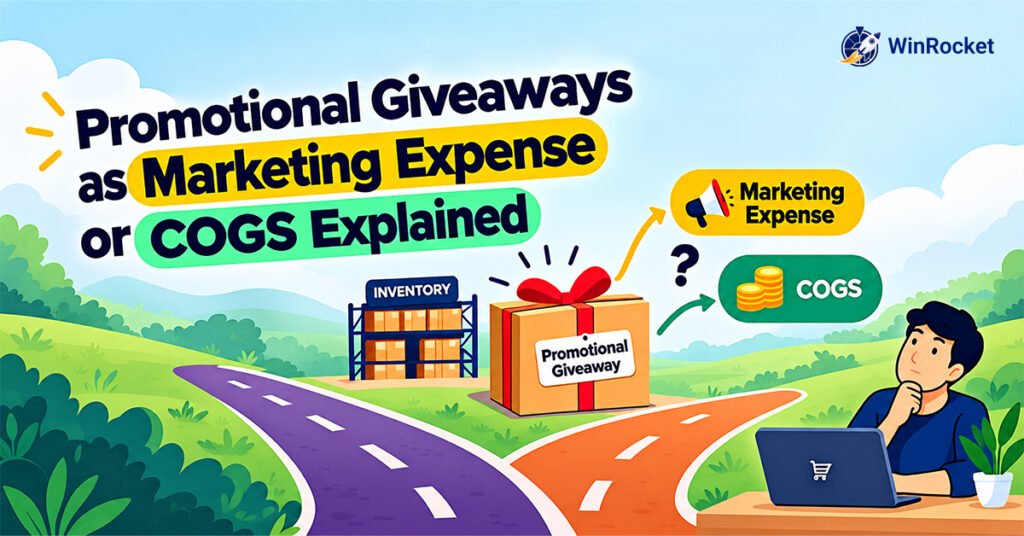
Imagine your WooCommerce store sells a popular product for $100. That item costs your business $35. Instead of waiting for a buyer, you use one unit in a WooCommerce giveaway campaign. Your inventory drops by one unit, but zero cash enters the register. What happens to that $35 cost?
Smart store owners treat promotional giveaways as a marketing expense rather than as regular sales. This inventory movement is not tied to a product sale. Its main business purpose is brand growth and new customer traffic. Because of this, that cost shifts away from COGS on your books.
ASI reported that North American promotional-products distributor sales reached $27.7 billion in 2025, up 4.2% from 2024. Product-based promotion is clearly a major marketing activity, but the financial treatment still depends on how the product is used.
This guide explains when promotional giveaways as marketing expenses may apply, how they affect margins, and which records an eCommerce business should keep.
Why Do Promotional Giveaways Need Separate Accounting Treatment?
Promotional giveaways need separate accounting treatment because stock leaves shelves without generating customer revenue. In a regular sale, you exchange inventory directly for cash. A promotional giveaway breaks that simple balance into three parts.
Every time you run a campaign, your business goes through three separate actions. Many store owners get confused because these steps happen together. Here is what happens when an item leaves your warehouse.
- Physical inventory movement: A product leaves inventory, which creates an immediate reduction in your shelf stock.
- Revenue event: Unlike regular product sales, a giveaway brings zero money into your store bank account.
- Expense classification: Your business still paid for that stock, so that expense needs to be assigned to a proper category.
Because of this split, you must follow your true business purpose. Inventory movement, expense classification, and tax treatment are related, but they are not the same question. A physical stock drop does not automatically determine expense categories.
Once a giveaway item leaves your stock, your inventory records should reflect that it is no longer available for sale. However, that stock movement does not automatically tell you which expense category to use.
That depends on why the product left inventory in the first place. A customer purchase, a promotional giveaway, and a damaged item may all reduce stock, but they represent very different business events.
This is the distinction to keep in mind as we move to the main question: should a promotional giveaway be classified as a marketing expense or COGS?
Promotional Giveaways as Marketing Expense: COGS Explained
Promotional giveaways used purely for promotion may be recorded as marketing or advertising expenses rather than normal COGS. The key question is not simply whether inventory left your store, but why it left.
For example, a product given away to attract attention has a different purpose from a product delivered as part of a paid order. That business purpose helps explain why the costs may appear differently.
PwC illustrates the distinction with free-product examples. A product distributed for promotion and not linked to a sale is classified as a marketing expense in this example.
By contrast, an additional product supplied as part of a sales promotion can remain included in COGS because it is part of the overall sale.
That gives us a useful starting point. Now we can look at situations where giveaway costs are more directly tied to marketing.
When Giveaway Costs Belong to Marketing Expenses
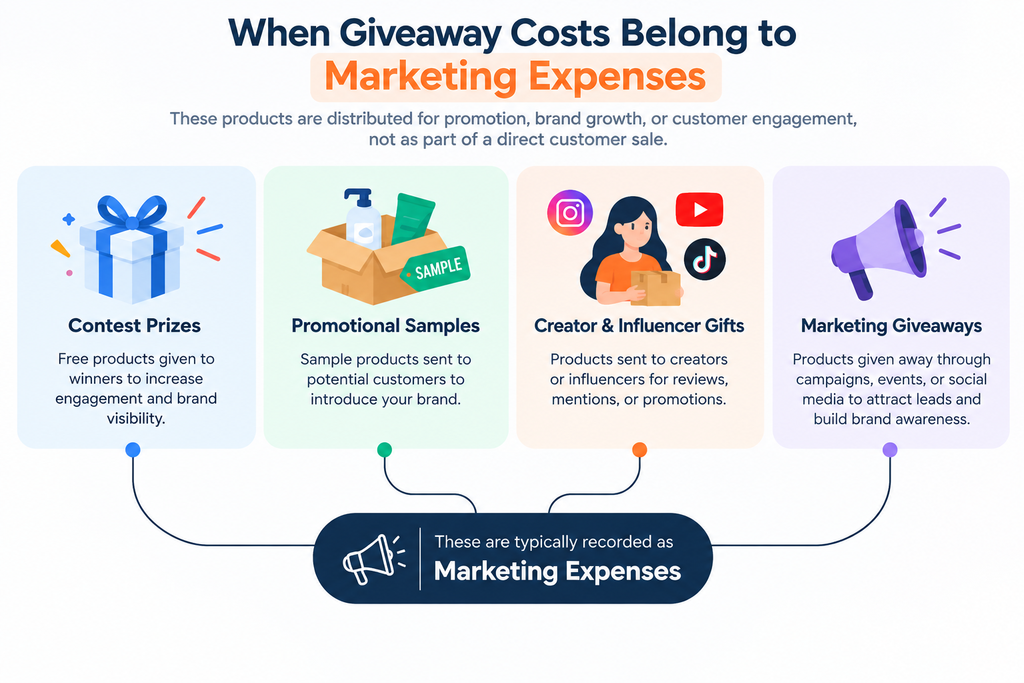
Some giveaway products have a clear promotional purpose. A store might use them to attract leads, introduce a product, build brand awareness, or encourage engagement with a campaign.
Contest prizes, promotional samples, marketing giveaways, and products sent to creators can all fall into this group when they are distributed for promotion rather than as part of a customer sale.
In a perpetual inventory system, the inventory record also needs to reflect that those units have left stock. Their related cost may then be recognized in an appropriate marketing or advertising expense account.
However, the exact entry still depends on the business’s accounting method and policy. The promotional purpose helps explain the transaction, but it should not be treated as a universal rule for every business.
The difference becomes clearer when a free product is tied to an actual sale.
When COGS Can Still Matter With Free or Discounted Products
Free does not always mean marketing expense. If an additional product is part of a revenue-generating transaction, such as a buy-one-get-one offer or a gift-with-purchase, its cost may remain included in the cost of sales.
PwC’s example makes the distinction easy to see. When a customer receives 13 tablets for the price of 12, the incremental tablet is classified as COGS because it forms part of the overall sales transaction. The zero-dollar price of that extra unit does not make it a separate marketing giveaway.
That is why the structure and purpose of the transaction matter more than simply asking whether the customer paid for that individual item.
Not Every Free Product Is a Promotional Giveaway
Many business blogs mistakenly treat all zero-dollar inventory as promotional marketing. In reality, warehouse stock leaves your shop for several non-promotional reasons. You might issue a warranty replacement, discard damaged stock, or use an item personally.
A damaged unit represents an inventory write-off, not a promotional campaign expense. Customer replacements belong to customer service or warranty accounts. Use the quick comparison table below to identify the right category to evaluate.
| Scenario | Revenue Connection | Main Business Purpose | Expense Category to Evaluate |
| Normal product sale | Direct | Revenue | COGS |
| Promotional giveaway | None | Marketing | Marketing/promotional expense |
| Influencer seeding | Usually none | Promotion | Marketing expense |
| Gift with purchase | Connected | Sales promotion | COGS may apply if tied to the sale |
| Replacement product | Existing customer sale | Service or warranty | Not automatically marketing |
| Damaged inventory | None | Inventory loss | Write-off or other inventory treatment |
Use this table as a classification framework, not as a tax rule. Financial reporting treatment and tax treatment can differ depending on the transaction, jurisdiction, and accounting method.
How Much Does a Promotional Giveaway Really Cost a Business?
For a store that tracks inventory at cost, a promotional giveaway is measured by the units’ inventory cost, not simply their retail selling price. Suppose you give away 10 products that normally sell for $100 each but cost your business $35 per unit. The inventory cost involved is $350, while the $1,000 figure represents their normal retail value.
Those numbers answer different questions. Retail value shows what customers would normally pay. Inventory cost reflects the amount carried under your applicable inventory-costing method. To understand the marketing campaign itself, you then need to add the other costs required to run it.
💡 Important Distinction Box
Retail value: What customers normally pay for the item.
Inventory cost: What your business paid or incurred to acquire or produce the units.
Full campaign cost: Product inventory cost plus all extra expenses needed to run the promotion.
Store owners can use a simple formula to calculate true campaign spend. Add product inventory cost, delivery fees, paid promotion, and fulfillment together. This sum reveals your total campaign cost without confusing retail selling prices with cash outlay.
For stores that value inventory at cost, the number that matters here is the cost assigned to those products, not simply their selling price. IRS Publication 538 explains how inventory cost can include acquisition or production costs.
So if a product sells for $100 but has an inventory cost of $35, those figures answer two different questions. One is what the customer would pay; the other reflects the product’s recorded cost.
That distinction also gives us a better starting point for calculating the total cost of the giveaway campaign.
How Do Giveaway Costs Affect Gross Margin and Profit Reporting?
How you classify giveaway costs can affect how gross margin appears in your reports. If the cost sits within COGS, gross profit looks different than when that same cost is recorded separately as a marketing expense.
Here is a simple hypothetical example. The figures below are for explanation only and do not represent an actual WooCommerce store.
Suppose a WooCommerce store earns $20,000 in revenue. The products it sold cost $8,000, and another $2,000 of inventory is used for a promotional giveaway.
| Scenario | Treatment | Result |
| Scenario A | Giveaway Cost Included in COGS | If the $2,000 giveaway cost is included in COGS, total COGS becomes $10,000. Gross profit falls to $10,000, giving the store a 50% gross margin. |
| Scenario B | Giveaway Cost Recorded as Marketing Expense | If the applicable accounting policy treats the $2,000 separately as a marketing expense, COGS stays at $8,000. Gross profit becomes $12,000, resulting in a 60% gross margin. |
The giveaway still costs the business $2,000 in both scenarios. What changes is where that cost appears, which affects reported gross profit and gross margin. This simplified example excludes other operating expenses.
In this simplified example, the business still has $10,000 left after accounting for the giveaway cost, before other operating expenses. What changes is how product margin and marketing spend appear in the financial report.
What Giveaway Costs and Records Should Your Business Track?
Ecommerce businesses should retain sufficient information to reconcile the products distributed, their associated costs, and the business purpose of each giveaway. Clear records make inventory reviews, campaign analysis, and discussions with an accountant much easier.
A giveaway can affect both inventory records and expense or campaign records. The exact workflow depends on the accounting and inventory systems the business uses, which is why documenting the transaction when it happens is more reliable than reconstructing it months later.
Standard Giveaway Record-Keeping Checklist
Keep this practical checklist handy before launching any new marketing promotion. These core fields give your accountant everything needed for smooth monthly reconciliations. Review each item below to keep your store documentation complete and audit-proof.
- Campaign details: Campaign name, launch date, and business purpose.
- Product metrics: Item SKU, giveaway quantity, and retail value.
- Cost tracking: Unit inventory cost and total inventory cost.
- Logistics spend: Delivery fees, custom packaging, and advertising spend.
- Final reconciliation: Fulfillment expense, winner records, and total campaign cost.
Save these supporting records alongside your standard monthly inventory adjustment entries. Proper documentation proves that missing stock was distributed for marketing rather than lost or damaged. This habit protects product profitability records and keeps bookkeeping neat.
One more distinction matters here. How you classify a giveaway in your accounts does not automatically decide whether the expense is tax-deductible. Tax rules are a separate question.
For U.S. businesses, IRS Publication 334 states that deductible business expenses must generally be ordinary and necessary. It also lists advertising as a type of business expense that may be deductible.
Business gifts can face different rules. IRS Publication 463 generally limits deductions for business gifts to $25 per recipient per year, with exceptions for certain low-cost promotional items.
That does not mean every promotional giveaway is automatically a business gift. Because the treatment depends on the circumstances, confirm the tax side with an accountant or tax professional in your jurisdiction.
How Can WooCommerce Stores Run Better Promotional Giveaways
Once the accounting side is documented, the next challenge is running the campaign itself. WooCommerce stores still need to manage entries, tickets, winners, and campaign performance without turning the process into manual admin work.
That is where WinRocket fits. It manages the giveaway workflow inside WooCommerce, while your accountant or bookkeeping system remains responsible for financial and tax classification.
- WinRocket can generate and email ticket numbers automatically based on the order status you configure. Pro also adds ticket prefix and suffix branding and per-order ticket limits.
- Its winner system supports automated random winner selection and visual winner-reveal options such as fireworks and a spinning wheel.
- The Viral Share extension can reward actions such as shares, follows, and referrals with bonus giveaway entries.
- Campaign analytics can track sales, revenue, orders, unique participants, and winner history for individual giveaways.
Together, these features keep ticket handling, winner selection, social-entry actions, and campaign reporting inside the WooCommerce workflow. Store owners can review campaign activity without managing each entry and draw through separate spreadsheets or manual records.
The broader promotional products industry also provides context for why brands continue to invest in physical giveaways. PPAI’s Product Power 2026 study surveyed more than 5,000 U.S. respondents.
The study found that 90% agreed that promotional merchandise improved their perception of the brand. Around 83% also said receiving a promotional product made them feel appreciated.
Those findings are encouraging, but they do not guarantee the same result for a WooCommerce giveaway. The prize, audience, entry experience, promotion, and campaign setup still shape the outcome.
In other words, good giveaway software can organize the campaign, but the campaign itself still needs a clear marketing goal and sensible cost tracking.
Run WooCommerce Giveaways Without Distorting Gross Margins
In the end, that $35 product leaving your shelf shouldn’t cause bookkeeping panic. Items leaving inventory do not automatically mean normal COGS. Your product cost follows its true promotional purpose.
First, product distribution reasons and customer sales connections dictate your accounting category. Next, never confuse retail value, unit inventory cost, and total campaign expenses. Clear distinctions protect reported product profit margins from artificial drops.
Proper marketing expense classification gives your store financial clarity. Successful WooCommerce stores scale by pairing responsible cost tracking with disciplined campaign management. Accurate numbers empower you to protect store profits.
Stay updated with practical giveaway tips, WooCommerce growth ideas, WinRocket updates, and upcoming offers through our newsletter. Join our active merchant community or follow WinRocket on X and LinkedIn for fresh campaign strategies.
Frequently Asked Questions
Are promotional giveaways considered marketing expenses or COGS?
Promotional giveaways are classified as marketing expenses when you distribute items for free to build brand awareness. Because no product is sold, this inventory cost is excluded from normal COGS. This classification keeps your true product profit margins accurate on financial reports.
Can I write off the retail price of a giveaway item?
No, you can only deduct the actual inventory cost paid for that item. Tax authorities never allow stores to deduct lost retail profits or hypothetical selling prices. Always record the actual purchase cost plus direct delivery fees on your books.
How do I record a promotional giveaway in my accounting books?
You record a giveaway by transferring product cost out of inventory assets. Debit your marketing expense account and credit your inventory asset account directly. This entry keeps physical warehouse stock counts aligned with financial records.
When does a free item remain inside Cost of Goods Sold?
A free item stays inside COGS when bundled directly with a paid customer transaction. Examples include buy-one-get-one deals and gift-with-purchase promotions. Because incoming sales revenue covers the extra unit, its cost remains tied to the cost of sales.
Does the IRS limit tax deductions for promotional giveaway items?
General advertising costs are normally deductible under IRS rules without a dollar ceiling. However, gifts given to specific individuals are subject to a strict $ 25 annual limit. Widely distributed items displaying your logo generally qualify as standard advertising expenses.
Start Running Giveaways Today
Join 300+ WooCommerce stores already boosting sales & engagement with WinRocket.
Free forever · 14-day pro refund · No credit card needed for free version