

Giveaway Marketing Strategy 2026: What Most Brands Keep Missing
What if your best-invested giveaway is actually one of your weakest marketing campaigns this year? High entries, loud engagement, and rapid follower growth can hide a campaign that creates little lasting value.
That hidden weakness usually appears after the winner is announced and the campaign excitement begins to fade. Sales may remain flat, new followers may leave, and very few entrants return without an additional incentive.
A strong giveaway marketing strategy demonstrates whether campaign attention can translate into real business results. It connects audience quality, campaign actions, follow-up, conversions, and ROI with the goals you set before launch.
This guide will help you turn giveaway attention into a strategy that attracts better entrants and supports growth. But before fixing the strategy, we need to understand why seemingly successful giveaways can still deliver disappointing business results.
Why Do Successful-Looking Giveaways Still Fail to Create Value?
The giveaway that fails spectacularly in front of everyone is not the riskiest. It is the one that appears to be successful while subtly drawing in potential clients.
Giveaways often fail despite high entry numbers because attention and business value are not the same. Strong activity can still hide weak audience quality, low customer intent, and poor conversion afterward.
Imagine a skincare store offers a new smartphone and gets thousands of entries within several days. Many people may want that giveaway prize – phone, but far fewer may care about skincare products afterward.
That is why “raw entrants” and “qualified entrants” should never mean the same thing here. A raw entrant completes the task, while a qualified entrant actually fits the brand’s target audience.
The gap grows wider when entry actions have no clear link to the campaign goal. More follows or shares become vanity metrics when those people never return, subscribe, browse, or buy later.
Without useful follow-up, most non-winners have little reason to stay connected after the giveaway ends. That weak path can hurt customer acquisition and leave brands with attention that disappears quickly.
SweepWidget’s 2026 platform study analyzed more than 70,000 contests and giveaways across eight years of data. That scale shows how much participation campaigns can create.
But participation is only one side of the story. HubSpot’s 2026 data supports that shift. Lead quality led at 39%, followed by conversion at 34%, ROI at 31%, and customer acquisition cost at 30%.
So brands should measure giveaway success by campaign performance, conversion rates, customer acquisition, and campaign ROI. The next step is learning how to attract qualified entrants, not simply collect more names.
How to Build a Giveaway Marketing Strategy That Drives Value?
Many weak giveaways start with one exciting question: “What should we give away?” The better question is, “What should this campaign actually achieve?”
That shift changes the whole giveaway marketing strategy. Goal, audience, prize, entry method, distribution, and follow-up should all support the same business outcome.
So before choosing the prize or planning any entry action, the campaign needs one clear goal to guide every decision.
Let’s start there and figure out what your giveaway really needs to achieve.
1. Set a Clear Goal Before Planning the Giveaway
Before you plan anything else, decide the one business result your giveaway should create first. A goal like “more engagement” sounds positive, but it gives you no clear way to judge success.
Instead, choose one clear outcome, such as email growth, product discovery, qualified leads, referrals, or sales. Then match that outcome with one primary KPI, so every later decision has a clear purpose.
For example, Instagram likes mean little when your real goal is building a useful email list. Likewise, a huge entry count cannot prove success when revenue is the result you actually want.
Once the campaign goal is clear, your giveaway marketing strategy becomes much easier to shape and judge.
Choose the Right Giveaway Campaign Solution
Once the campaign goal is clear, choose the giveaway solution that directly supports it. The right solution should guide the prize, entry method, and campaign format together.
For example, a WooCommerce store that wants referral reach may need social sharing actions. A store that wants to generate more interest in its products may need a prize closely tied to its own products.
This is where the Prize-Audience Fit Test still matters. Ask this: Would someone with no interest in your products still really want this prize?
If so, the campaign may attract people for the reward rather than for your brand. A $1,000 cash prize can pull a wide crowd, but a product bundle can attract a more relevant audience.
That still does not guarantee sales. However, it gives the campaign a better chance of attracting qualified entrants rather than chasing a larger, weaker crowd.
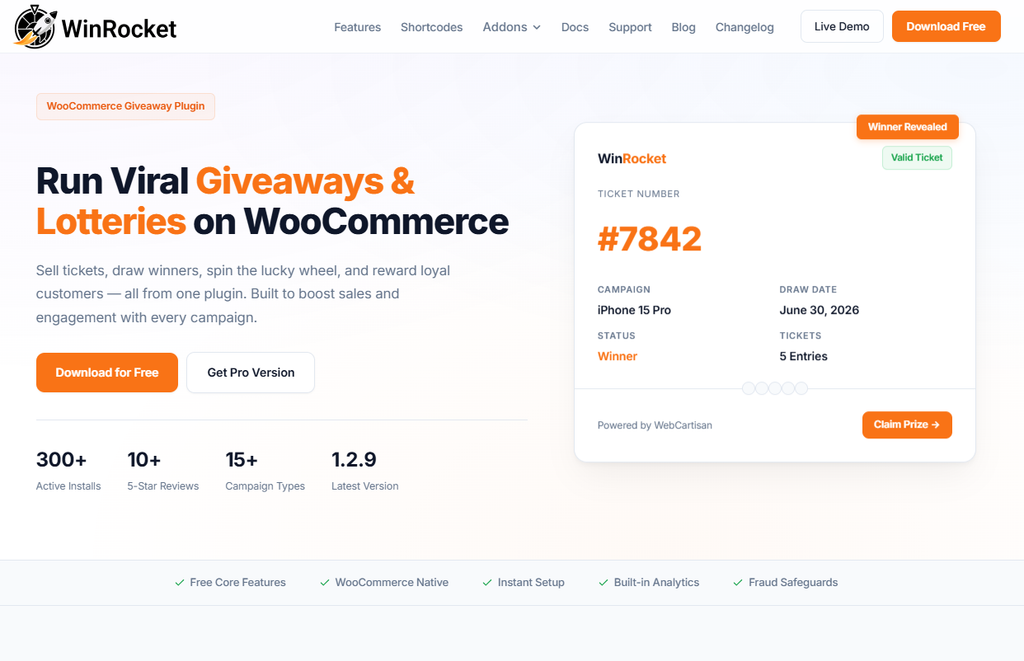
💡 Pro Tips: If your online store is built in WooCommerce, you can consider WinRocket – all-in-one giveaway lottery plugin.
Keep Entry Simple but Reward Valuable Actions
Once the campaign solution attracts the right people, the next step is to make entry feel easy. If the process feels like work, even interested people may leave before they finish.
Start with one clear action, then offer additional actions as optional bonus entries. Those extras can include product visits, short questions, social shares, referrals, or another useful campaign action.
Shopify also recommends keeping giveaway entry simple and asking only for the information you actually need. Its guidance warns that long forms or too many requirements can push people away.
That is where the entry-friction ladder helps: an easy first step, a stronger commitment, then optional higher-value actions. This keeps entry smooth while still supporting referral marketing, lead generation, and stronger participant interest.
Plan Distribution Before the Campaign Goes Live
Even a clear campaign solution can feel invisible if the right people never discover it. So before launch, decide exactly where your campaign will get its first wave of attention.
Start with channels you already control, such as your website, email list, and social accounts. Then expand through referrals, brand partners, relevant creators, or paid promotion when those channels fit your goal.
However, more channels do not always mean better campaign distribution. Choose the places where your target audience already spends time, then keep the message consistent across each one.
That way, campaign promotion supports your giveaway marketing strategy instead of becoming a last-minute push for more entries.
Prepare the Follow-Up Before Choosing a Winner
After people find and enter the campaign, the plan should not stop on the winner’s day. Before launch, decide what happens next for both the winner and everyone else.
First, plan the winner message and the next step for non-winners. That could be useful content, a product offer, or another reason to stay connected.
Then consider new subscribers and participants who showed genuine interest during the campaign. A simple follow-up can guide them toward another action rather than letting that attention fade.
This keeps the customer journey moving after the giveaway ends. In short, follow-up should be part of the strategy from day one, not something added at the end.
What Do Most Brands Miss After Their Giveaway Winner Is Chosen?
Choosing a winner closes the draw, but it should never close the marketing opportunity for your brand. What happens next can decide whether participants trust you, stay interested, or disappear after the prize.
Once the draw ends, three areas deserve far more attention than most brands usually give them.
- Winner transparency: People need clear proof that the draw ended fairly and someone actually received the promised prize.
- Non-winner follow-up: Most entrants will not win, but many may still have a real reason to stay connected afterward.
- Marketing permission: A giveaway entry does not automatically grant brands permission to send unlimited promotional messages later.
After a giveaway ends, brands should clearly announce the winner, guide non-winners on next steps, and confirm marketing consent before any further promotion.
A strong post-campaign follow-up should protect trust, support audience retention, and keep interested participants connected afterward. The goal is not to message everyone but to guide the right people toward another useful action.
- Close the trust loop: Publish a clear winner announcement and confirm that the promised prize was actually awarded.
- Guide non-winners forward: Offer helpful content, a relevant product path, or another reason to stay connected.
- Check consent first: Confirm what entrants agreed to before adding them to future promotional messages or campaigns.
That final point matters because marketing consent can change what brands are allowed to do next. The UK ICO explains that prize-draw consent does not automatically extend to unrelated marketing.
In the United States, the FTC says sweepstakes-type promotions that require a purchase are illegal. Some state laws may also require disclosures, licenses, or bonds for certain promotions.
Rules differ by campaign type and location, so brands should verify requirements before running future promotions. This article gives general guidance only and should not replace legal advice for a specific campaign.
Measure Giveaway Results Beyond Entries, Likes, and Shares
After the winner is chosen, your giveaway marketing strategy still needs to answer one important question: what did that attention actually produce? Entries show participation, but they do not indicate whether the campaign created real business value.
Before checking formulas, look at the campaign signs first. These patterns can point toward the part of your giveaway strategy that needs closer attention.
| What you see | What to investigate |
| Many entries, few conversions | Prize or audience mismatch |
| Low entries, strong conversions | Distribution weakness |
| High traffic, few entries | Entry friction |
| Strong follower growth, fast churn | Low audience relevance |
| Good participation, no later action | Follow-up failure |
The six checks below follow the campaign from entrant quality to final return. These are practical campaign formulas, not universal industry standards, so define each input clearly before comparing results.
Step 1: Check Entrant Quality
Start by asking whether the right people actually joined your giveaway campaign. A large entry count means little when most participants fall outside your target audience.
Qualified entrant rate = Qualified entrants ÷ Total entrants × 100
This rate indicates the quality of the giveaway audience and shows how many entrants were truly relevant.
Step 2: Measure Lead Conversion
Next, check whether those qualified entrants moved beyond simple participation. The goal is to see how many become useful leads for future marketing.
Entry-to-lead rate = Valid leads ÷ Total entrants × 100
This rate connects giveaway activity with lead generation and gives you a clearer view of conversion.
Step 3: Track Referral Contribution
Now look at how much campaign growth came from participants rather than your own promotion. This is where referral marketing becomes easier to judge.
Referral contribution = Referred entrants ÷ Total entrants × 100
A higher share shows that participants helped expand the campaign through referrals, not only through direct promotion.
Step 4: Calculate Cost per Qualified Lead
At this point, connect audience quality with campaign cost. Raw cost per entrant can look cheap while useful leads remain expensive.
Cost per qualified lead = Total campaign cost ÷ Qualified leads
This figure shows what you spent to attract each relevant lead and supports better customer acquisition decisions.
Step 5: Measure Post-Campaign Value
Next, check what participants did after the giveaway ended. Look at post-campaign conversion, audience retention, and campaign revenue together.
These metrics show whether entrants returned, made a purchase, remained engaged, or took another valuable action after the campaign.
Step 6: Review Campaign ROI
Finally, compare measurable returns with total campaign costs to review your giveaway campaign ROI. Define what counts as a return first, so your campaign analytics stay clear.
Do not judge success only on the winner’s day. Check results at campaign end, after seven days, and again after thirty days.
This timeline is a practical review framework, not an industry benchmark. It helps measure giveaway success through conversion, audience retention, customer acquisition, and campaign ROI.
How Do WooCommerce Stores Put a Giveaway Strategy Into Action?
A giveaway marketing strategy becomes practical when you choose a mechanic that actually fits the result you want. The feature should follow that goal, not lead it.
That is why the business goal should come first, with the campaign format following. For WooCommerce stores, WinRocket helps turn that strategy into a real giveaway campaign inside WooCommerce. The table below shows how each goal can be matched to a useful WinRocket option.
| Business goal | Best-fit mechanic | WinRocket example |
| Grow referral reach | Social sharing | Viral Share |
| Increase interaction | Interactive campaign | Lucky Wheel or Instant Win |
| Add another reward chance | Extra draw | Bonus Draw |
| Run inside WooCommerce | Ticket-based workflow | WinRocket campaign management |
For referral growth, Viral Share is a good fit because participants can help spread the giveaway campaign through social sharing. That gives referral marketing a clear job instead of treating every share as a random activity.
If the goal is stronger interaction, Lucky Wheel or Instant Win can make participation feel more active. Those formats work best when the campaign needs more than a simple enter-and-wait experience.
Bonus Draw can add another layer of rewards when that extra chance supports the campaign goal. It should serve the giveaway campaign strategy, not appear only because another feature looks exciting.
For a WooCommerce giveaway campaign, WinRocket can also support giveaway tickets, winner selection, and campaign management. Campaign analytics can then help WooCommerce store owners review how the campaign performed after launch.
WinRocket works best when the campaign goal stays in control. Choose the mechanic because it supports that goal, not simply because the feature is available.
The goal chooses the mechanic, and the mechanic helps bring the plan to life.
Turn Your Next Giveaway Marketing Strategy Into Real Results
A giveaway should leave your business with more than a short burst of entries and attention. The real win comes when the right audience joins, takes meaningful action, and creates results you can measure.
That is what turns giveaway attention into something your store can actually measure and use. For WooCommerce brands, WinRocket can help turn that plan into a real giveaway campaign with clear campaign management.
Keep in mind, your next campaign should not just look busy. It should work toward something useful.
Stay updated with practical giveaway tips, WooCommerce growth ideas, WinRocket updates, and upcoming offers through our newsletter. You can also join our community or follow WinRocket on X and LinkedIn for more campaign ideas and product updates.
Frequently Asked Questions
1. How Often Should a Brand Run Giveaways?
There is no fixed giveaway frequency that works for every brand. Run a new campaign when it supports a clear goal, then review audience engagement, campaign performance, brand value, and customer retention before deciding whether another giveaway makes sense.
2. How Many Winners Should a Giveaway Have?
The right number of giveaway winners depends on your campaign objective, prize structure, and available budget. One winner can make a prize feel more exclusive, while multiple winners can distribute the reward among more participants without significantly diluting the prize’s value.
3. How Can Brands Prevent Fake or Duplicate Giveaway Entries?
Brands can reduce fake entries by implementing clear giveaway rules, entrant verification, and duplicate-entry checks. No system can remove all giveaway fraud, so campaign integrity also depends on reviewing suspicious activity before confirming a winner or awarding the prize.
4. What Happens If a Giveaway Winner Does Not Respond?
Follow the winner notification and prize claim process stated in your giveaway rules. If the winner misses the stated deadline, the rules may allow an alternate winner to be selected after any required eligibility verification, rather than changing the process after the campaign ends.
5. Should a Brand Open Its Giveaway to International Entrants?
An international giveaway only makes sense when the brand can manage giveaway eligibility, prize fulfillment, and shipping costs. Define eligible countries before launch, then check taxes, customs, and local giveaway rules that may affect how the prize can be awarded.
Start Running Giveaways Today
Join 300+ WooCommerce stores already boosting sales & engagement with WinRocket.
Free forever · 14-day pro refund · No credit card needed for free version